
Table of Contents
Missing teeth can make everyday life uncomfortable. Eating becomes difficult, speech may not feel clear, and many people start hiding their smile. While options like dentures and bridges are available, they don’t always feel stable or natural over time.
That’s where titanium dental implants make a real difference. These implants are fixed inside the jaw and act like natural tooth roots, so the replacement teeth stay secure. You can eat properly, smile confidently, and go about your day without worrying about movement or discomfort.
Today, titanium implants are one of the most trusted solutions in modern dentistry. Dentists recommend them because they are strong, safe, and long-lasting. In this guide, you’ll learn how titanium dental implants work, their benefits, possible side effects, and whether they are the right option for you.
Dental treatments were very different earlier. People mostly depended on dentures or bridges to replace missing teeth. These options helped, but they often slipped, felt bulky, or needed frequent adjustments. Many patients were never fully comfortable with them.
The real change came when titanium started being used in dental implants. Dentists noticed that this metal can naturally join with the jawbone over time. This process creates a strong base for artificial teeth, something that older treatments could not offer. Because of this, implants don’t just sit on the gums, they become part of your mouth structure.
This discovery made tooth replacement more stable and long-lasting. Today, titanium implants allow patients to eat, speak, and smile with confidence, without the daily worry of movement or discomfort. That’s why they are now a preferred choice in modern dentistry.
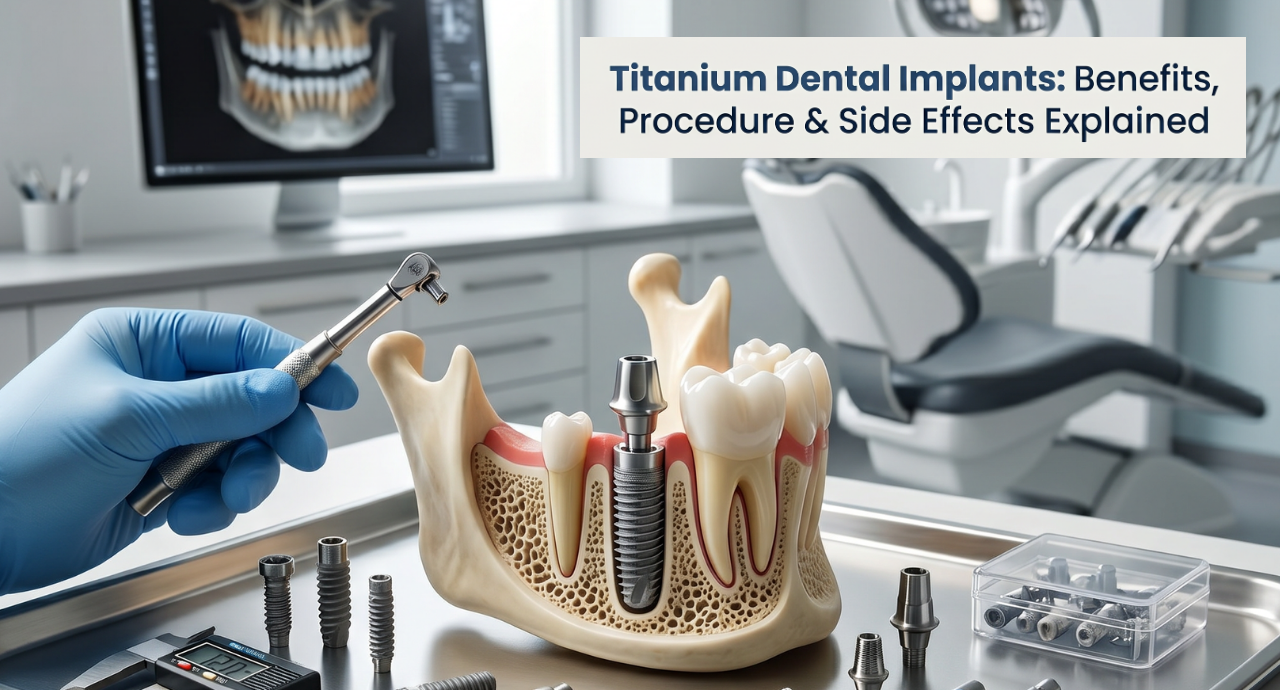
Titanium dental implants are small, screw-like posts made from medical-grade titanium. They are placed into the jawbone to act as artificial roots for missing teeth. Once the implant becomes stable, a crown (the visible tooth) is fixed on top, giving a natural-looking and long-lasting replacement.
If you’re exploring dental implant treatment, this is the basic concept behind it. The implant goes inside the bone and supports the new tooth, so it stays firm and does not move like removable options.
What makes titanium implants reliable is how they bond with the jawbone over time. This creates a strong base for the artificial tooth. Because of this, most people can eat comfortably, speak clearly, and smile without feeling any looseness.
Titanium is not just any metal. It works well inside the human body, which is why it is also used in joint replacements and medical devices. When placed in the jaw, titanium is accepted by the body and slowly joins with the bone. This bonding makes the implant strong and stable.
This strength becomes even more important in treatments like full mouth dental implants, where multiple teeth are replaced together and need solid support. Titanium can handle this pressure well, making it a reliable choice for both single and full-mouth restorations.
Another reason dentists prefer titanium is its durability. It can handle daily chewing without bending or breaking, and it does not rust or get damaged inside the mouth. Because of this, implants made from titanium are known to last for many years. Titanium is also safe for most people, with very rare chances of any reaction, which makes it one of the most trusted materials in dental care.
Titanium dental implants come in different types based on how they are placed and how they are designed. The choice depends on your bone condition and treatment needs.
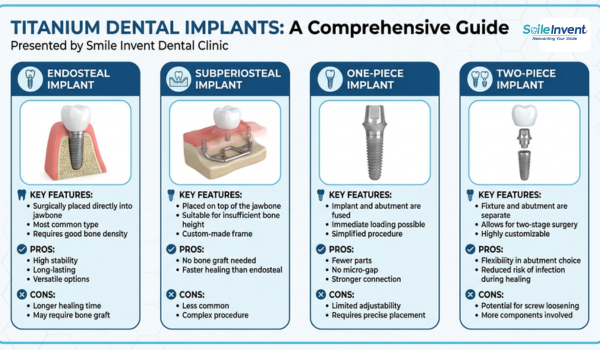
These are the most commonly used implants. They are placed directly into the jawbone and act like artificial tooth roots. Once healed, they provide strong support for crowns or bridges. This type is suitable for patients who have good bone density.
These implants are placed on top of the jawbone but under the gum tissue. They are usually recommended when the jawbone is not thick enough for regular implants and bone grafting is not preferred.
In this type, the implant and abutment are combined into a single unit. This means fewer steps during the procedure. It can be helpful in certain cases where faster treatment is needed.
These are the most widely used today. The implant is placed first, and after healing, the abutment is attached. This gives better flexibility and allows proper alignment of the final tooth.
The process of getting a titanium dental implant is done in steps, and it usually takes a few months from start to finish. Each stage is important to make sure the implant becomes strong and long-lasting.
The first step is a detailed check-up. The dentist examines your teeth, gums, and jawbone using X-rays or scans. This helps in planning the exact position of the implant and checking if your bone is strong enough.
In this step, the titanium implant is placed into the jawbone through a minor surgical procedure. It is done under local anesthesia, so you won’t feel pain during the process. After placement, the gums are closed to allow healing
This is the most important stage. Over the next 3 to 6 months, the implant slowly joins with the jawbone. This bonding makes the implant stable and strong enough to support a tooth.
Once healing is complete, a small connector called an abutment is attached to the implant. This part will hold the final tooth in place.
In the final step, a custom-made crown is fixed on top of the abutment. It is designed to match your natural teeth, so it looks and feels normal.
Titanium dental implants are known for their strong track record. Studies over many years show that their success rate is usually above 95%, and in many cases even reaches 97–98% over long periods. This means most implants stay stable and work properly for many years when done correctly.
The reason behind this high success rate is how titanium bonds with the jawbone. Once healing is complete, the implant becomes firmly fixed in place, which reduces the chances of movement or failure. Research also shows that this stability continues even after 10 years, making titanium implants one of the most reliable options for tooth replacement.
If you want to understand the basics before going deeper into success rates, you can read this complete guide on dental implants to get a clear picture of how the entire treatment works.
Still, success also depends on a few factors. Good oral hygiene, healthy gums, proper bone support, and following the dentist’s advice all play a role. People who smoke or have uncontrolled medical conditions may have slightly lower success rates, so proper care is always important.
Titanium dental implants offer many practical advantages, which is why they are widely preferred for tooth replacement.
Titanium is a very durable material. Once the implant bonds with the bone, it can last for many years, often even a lifetime with proper care.
The implant stays fixed in the jaw, so it doesn’t move while eating or speaking. This makes it feel very similar to your natural teeth.
You can eat most foods comfortably, including harder items, without worrying about slipping or discomfort.
When a tooth is missing, the jawbone in that area can shrink over time. Implants help maintain bone strength by stimulating it, just like natural roots do.
Unlike bridges, implants do not require support from adjacent teeth. This helps keep your natural teeth healthy and untouched.
The crown placed on the implant looks natural and blends well with your existing teeth, helping you smile freely.
Caring for implants is simple. Regular brushing, flossing, and dental check-ups are enough to keep them in good condition.
Not everyone has the same dental condition, but many people can benefit from titanium implants. A proper check-up is always needed, but here are some general points that help you understand if you are a suitable candidate.
If you have lost a tooth due to decay, injury, or gum problems, implants can replace it in a stable and long-lasting way.
Good gum health is important because the implant needs support from the surrounding tissues. If there is gum disease, it may need treatment first.
The implant is placed in the jawbone, so there should be enough bone to hold it firmly. If bone is low, treatments like bone grafting can help.
Regular brushing, flossing, and dental visits are important to maintain the implant and prevent infection.
Implants are usually recommended for adults, as the jawbone should be fully developed before placement.
Smoking can slow down healing and affect success rates. Dentists may advise reducing or stopping smoking during the treatment period.
Conditions like uncontrolled diabetes or certain medical issues may affect healing. These can be managed with proper guidance from your dentist.
Titanium dental implants are generally safe and well-accepted by the body. Most people do not face any serious issues. Still, like any dental procedure, there can be a few side effects, especially in the early stage after surgery.
After the implant is placed, slight pain or swelling around the gums is common. This usually settles within a few days with basic medication.
If proper oral hygiene is not maintained, infection can develop around the implant area. This can be avoided with good care and regular dental check-ups.
In some cases, healing may take longer, especially for people who smoke or have certain health conditions.
Very rarely, the implant may not bond properly with the bone. This can happen due to poor bone quality or lack of care after the procedure.
Allergic reactions to titanium are extremely uncommon, but a few people may experience sensitivity.
Both titanium and zirconia implants are used to replace missing teeth, but they differ in material, strength, and long-term results. Here’s a simple comparison to understand the difference:
Titanium implants are still the most commonly used because they are strong, reliable, and backed by years of research. Zirconia can be a good option in specific cases, especially where appearance is a concern.
Titanium implants are a strong and long-term solution, but they may not be the right fit for everyone. Some people may have low bone support, budget concerns, or personal preferences. In such cases, there are other options that can help replace missing teeth and restore function.
A dental bridge is a fixed option that fills the gap using support from the nearby teeth. The dentist reshapes the adjacent teeth and places a bridge over them to hold the artificial tooth in place. It looks natural and works well for chewing, but it does involve altering healthy teeth, which some people may want to avoid.
Dentures are removable teeth replacements and are one of the oldest solutions. They are usually more affordable and quicker to make. Full dentures replace all teeth, while partial dentures are used when some natural teeth are still present. The downside is that they can feel loose over time and may need adjustments to stay comfortable.
Zirconia implants are a metal-free option made from ceramic material. They are white in color and may be preferred by people who want a more aesthetic or non-metal solution. While they do offer good results, they are not as widely used as titanium and have less long-term research available.
This is a combination of implants and dentures. A few implants are placed in the jaw, and the denture is fixed on top of them. This gives much better stability compared to regular dentures. It is a good option for people who have lost multiple teeth but may not want individual implants for each tooth.
Choosing the right clinic is just as important as choosing the right treatment. Titanium dental implants need proper planning, precision, and experience to give long-lasting results.
At Smile Invent Dental Clinic, patients are treated by experienced professionals, often recognized among the best dentists in Mumbai, who focus on both comfort and accuracy during the procedure. Each case is carefully checked before starting, so the implant is placed correctly and heals well.
The clinic uses modern equipment for detailed diagnosis and planning, which helps improve results. High-quality materials are used to ensure safety and durability. Patients are also guided at every step, so they understand the process and feel comfortable throughout the treatment.
Cleanliness and proper care are also given high importance. A hygienic setup along with regular follow-ups helps reduce risks and supports better healing.
Yes, titanium dental implants are considered very safe. Titanium is widely used in medical treatments because the body accepts it well. Most people do not face any issues, and implants have a high success rate when placed correctly.
No, titanium does not rust like regular metals. It is highly resistant to corrosion, even inside the mouth where there is moisture and saliva. This is one of the reasons why it lasts for many years.
No, dental implants are very small and usually do not trigger metal detectors. You can travel without worrying about this.
Yes, age is not a major barrier. Many older adults successfully get dental implants. What matters more is overall health and bone condition, not age alone.
Yes, titanium is non-magnetic, so it is generally safe during MRI scans. Still, it’s always a good idea to inform your doctor before any scan.
Yes, it is still possible. In cases of low bone density, procedures like bone grafting can be done to build support for the implant. Your dentist will guide you based on your condition.
Titanium dental implants have changed the way missing teeth are treated. They offer a strong, stable, and long-lasting solution that feels close to natural teeth. Whether it’s a single tooth or multiple teeth, implants help restore both function and confidence.
They are widely used because of their safety, durability, and high success rate. With proper care and regular check-ups, titanium implants can last for many years without major issues.
If you are dealing with missing teeth and looking for a reliable option, titanium dental implants are definitely worth considering. A proper consultation can help you understand if they are the right choice for your needs.
Walk into any supermarket or pharmacy and you will find toothpast...
Read More
Wearing braces can make your daily brushing routine a little more...
Read More
Have you ever noticed a small white mark on your tooth while look...
Read More